Best IPTV Devices in Ireland: The Definitive 2026 Hardware Review
Eoin O'Connor · Senior Network Infrastructure AnalystPublished June 16, 2026 · 8 min read
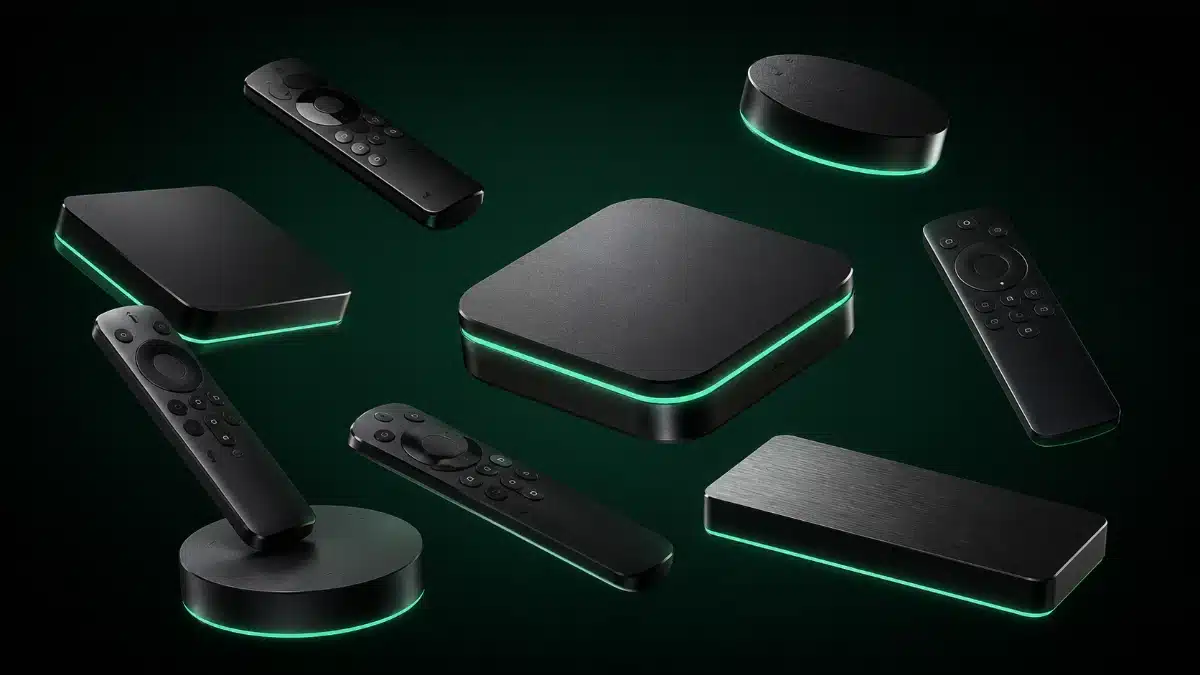
Feature illustration
The 2026 Hardware Tier Breakdown
For uncompressed 4K playback, your device choice directly determines stream stability. Streaming sticks carrying less than 2GB of RAM consistently fail under high-bitrate live data loads — the chip simply can't hold enough transport-stream buffer. For the best iptv devices 2026, hardware sorts into three clear tiers:
Premium TierNvidia Shield TV Pro
Maximum headroom, native codec hardware, Gigabit Ethernet.
The gap between a high-power streaming box and a low-profile HDMI dongle is mostly about thermal and memory headroom. A dedicated box runs a 64-bit quad-core (or better) ARM processor with a generous RAM allocation profile and active cooling, so it can hold a deep transport-stream buffer while decoding without throttling. A budget stick shares far less RAM, runs hot inside a sealed HDMI shell, and starts dropping frames the moment a live line pushes past its thermal ceiling.
The operating system matters as much as the silicon. Android TV and Google TV manage background process limits and RAM reclamation aggressively but predictably — they reserve memory for the foreground player, which keeps a 4K line stable. Generic, deeply customised operating systems on specialised boxes take a different route: they strip back the OS so almost all resources go straight to the media pipeline, which is why a leaner Linux box can feel faster than a more powerful general-purpose device.
The single biggest 2026 differentiator is native AV1 codec decoding. When the codec is handled in dedicated hardware rather than software, it reduces the local processor workload by up to 30%, lowering operating temperatures and eliminating the hardware-induced stuttering that plagues older sticks. If you're deciding what to buy IPTV Ireland hardware around, native AV1 support is the spec that future-proofs the purchase. (And remember — the device is only ever a neutral shell: see Is IPTV legal in Ireland? for where responsibility actually sits.)
The 2026 Spec Benchmarks for the Best IPTV Devices 2026
Here's how the leading consumer devices compare across the metrics that actually affect a live line in Irish homes. Note how a physical Ethernet port repeatedly outperforms wireless when you stress-test stability:
Device Model
RAM / Storage
Codec Support
Network Interface
Irish Market Rating
Nvidia Shield TV Pro
3GB / 16GB
AV1*, HEVC, VP9
Gigabit Ethernet + Wi-Fi
9.6 / 10
Fire TV Stick 4K Max (2nd Gen)
2GB / 16GB
AV1, HEVC, VP9
Wi-Fi 6E
9.1 / 10
Google TV Streamer
4GB / 32GB
AV1, HEVC, VP9
Gigabit Ethernet + Wi-Fi
9.3 / 10
Formuler Z11 Pro Max
4GB / 32GB
HEVC, H.264, VP9
Gigabit Ethernet + Wi-Fi
9.2 / 10
*Codec support varies by app and firmware version. Wired Ethernet is strongly recommended for bitrates above 25 Mbps — verify your own line stability any time by run an Irish IPTV status check.
Dedicated portal boxes work differently from general-purpose Android devices. Environments like Formuler's MyTVOnline (MOL3) and classic MAG portals run a Linux-based or deeply customised Android kernel that routes video through a dedicated transport-stream buffer, bypassing the standard Android media routing layers entirely. The payoff is responsiveness: because the stream is pre-buffered closer to the hardware, channel changes — "zapping" — happen in under 0.5 seconds, which feels dramatically snappier than a generic player loading each source from scratch.
That efficiency is also why these boxes are an excellent platform to evaluate a service on. A clean iptv free trial setup on a Formuler or MAG portal shows you the true ceiling of a line, without an overloaded OS muddying the result. Pair the box with a wired connection and you're testing the service itself, not your hardware's limits.
Buyer Checklist: What to Look For Before Purchasing
Before you commit to any device, confirm it clears these three bars:
Minimum 2GB RAM. Essential to prevent buffer overflow on continuous transport streams — anything less and live lines will stutter under load.
Dual-band Wi-Fi 6 or a Gigabit RJ45 port. Essential for processing stable bitrates above 25 Mbps on standard local fibre lines; wired is always the more reliable choice.
Sideload & terminal-shell capability. So neutral player shells (such as TiviMate or Smarters Player Lite) can be installed safely by following our IPTV setup guide for Ireland.
Hardware & Compatibility FAQ
Will a standard Smart TV's internal media player run as fast as an external 4K streaming stick?
Not usually. Built-in Smart TV chips are tuned for the TV's own apps and often have less spare RAM than a dedicated 4K stick or box. For demanding high-bitrate lines, an external device generally delivers smoother playback — though a recent flagship TV can hold its own.
Why do older hardware sticks drop frames on high-framerate (60fps) live sports streams?
60fps live sport is a high-bitrate, real-time feed with no pre-buffer. Older sticks lack the RAM headroom and codec hardware to decode it while holding a buffer, so they overheat and shed frames. AV1-capable hardware with 2GB+ RAM fixes this.
Does the device operating system affect internal security routing or custom DNS?
Yes. Android/Google TV expose system-wide DNS and network settings cleanly, while some portal boxes keep DNS at the device or firmware level. Either way you can apply a custom DNS — the menu location just differs. Our team can point you to the exact setting for your model.
Can I add USB-C storage to increase the application buffer space?
On many boxes, yes — external storage can host the app and expand cache, which helps on devices with limited internal memory. It won't replace RAM for live buffering, but it does ease storage-bound slowdowns.
HDMI 2.1 routingPower configuration
Hardware Ready
Got Your Streaming Hardware Ready to Deploy?
Test its computing limits with a raw, uncompressed high-bitrate line. Configure the best IPTV Ireland service for instant activation, or claim a hardware verification trial first. Need a hand? You can contact our customer service Irish IPTV team or head back to the home page.

 Feature illustration
 Memory allocation
 Clearing device cache
 HDMI 2.1 routing
 Power configuration
 Hardware verification seal